<h1>15 Rabbit Farming Business Mistakes That Can Destroy Your Profitability</h1>
<p>After 15 years on the ground managing commercial rabbitries in Nigeria and across West Africa, I have seen many enthusiastic entrepreneurs lose their entire investment within the first year. Often, these failures are not caused by a single catastrophic event but by a series of <strong>rabbit farming business mistakes</strong> that chip away at the farm’s health and financial stability. Whether you are operating a small backyard setup or a large-scale commercial enterprise, understanding these pitfalls is the difference between a thriving business and a closed gate. In this guide, we will break down the 15 critical errors that can destroy your farm and how to avoid them using proven field techniques.</p>
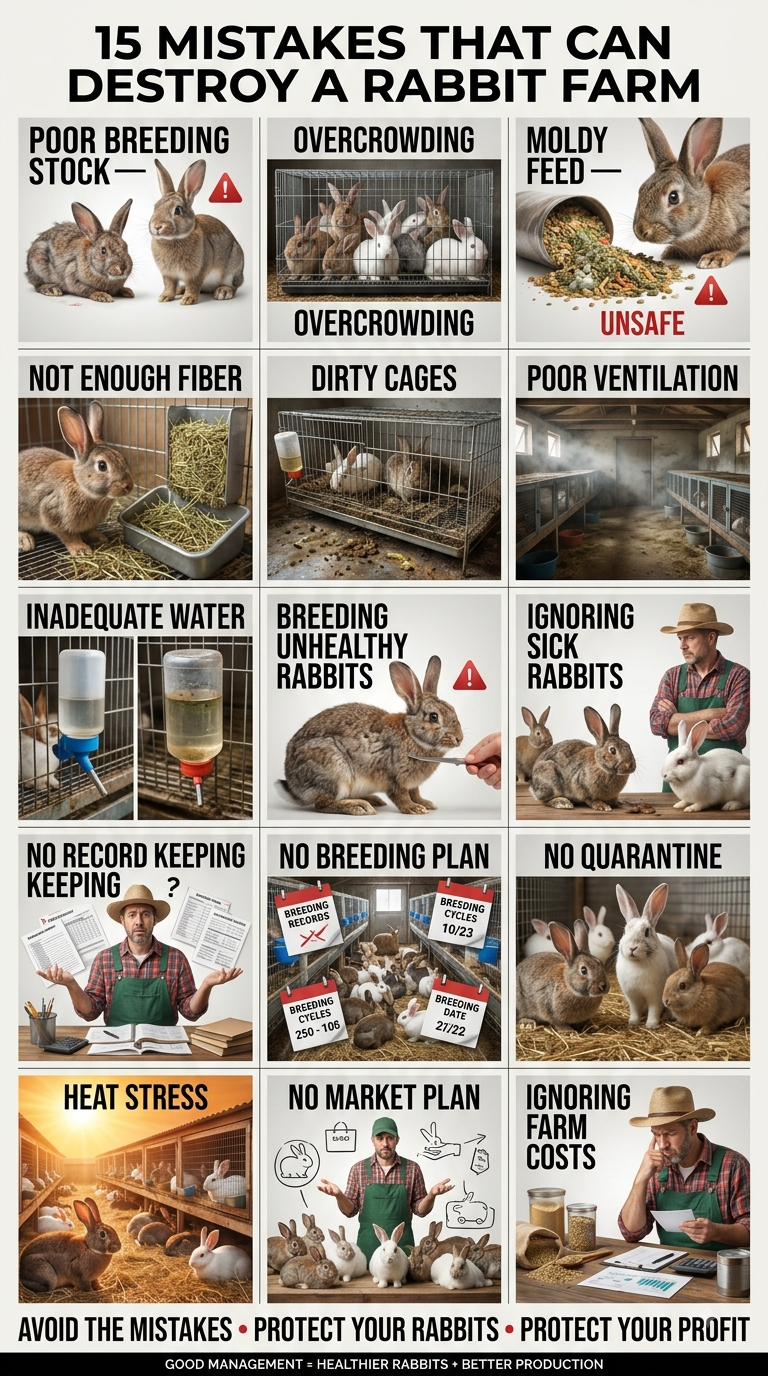
<h2>1. Genetic and Breeding Stock Failures</h2>
<p>The foundation of any livestock venture is genetics. Many new farmers make the mistake of buying "market rabbits" or local breeds with unknown histories. If you start with poor-quality breeding stock, no amount of expensive feed will make them grow fast enough to be profitable. To ensure success, you must select breeds specifically optimized for your climate and goals, such as those found in our guide on the <a href="https://farmtechbusiness.com/blog/10-best-rabbit-breeds-for-meat-production-a-commercial-guide-msok9q4c">10 Best Rabbit Breeds for Meat Production</a>.</p>
<h3>❌ Poor-Quality Breeding Stock</h3>
<p>Buying from middle-men instead of reputable breeders often results in stunted growth. You need rabbits that reach 2kg within 10 to 12 weeks. If your "purebred" Hyla or New Zealand White takes 5 months to reach market weight, your feed-to-meat conversion ratio is failing.</p>
<h3>❌ Breeding Unhealthy or Related Rabbits</h3>
<p>Inbreeding is one of the most common <strong>rabbit farming business mistakes</strong>. It leads to genetic depression, smaller litter sizes, and weak kits. Always maintain a pedigree record to ensure the buck and doe are not closely related. Additionally, never breed a doe that shows signs of respiratory distress (snuffles) or ear mites (canker), as these can be passed to the offspring.</p>
<h3>❌ No Strategic Breeding Plan</h3>
<p>Breeding without a schedule leads to "production peaks" and "dry spells." A professional farmer uses a calendar. For example, if you have 10 does, you should breed them in batches so that you have a consistent supply of meat for your customers every month, rather than 50 kits at once and then nothing for three months.</p>
<blockquote>PRO TIP: Always check the hock of a breeding buck before purchase. Sore hocks (pododermatitis) are hereditary and will cause the buck to stop mating due to pain.</blockquote>
<h2>2. Feeding and Nutritional Pitfalls</h2>
<p>Feed represents about 70% of your production costs. Many farmers try to cut corners here, which is a recipe for disaster. Rabbits have highly sensitive digestive tracts; one wrong move can lead to a 50% mortality rate overnight.</p>
<h3>❌ Giving Contaminated or Moldy Feed</h3>
<p>Aflatoxins in moldy maize or poorly stored pellets are silent killers. Always store your feed in a cool, dry place off the floor (on pallets). If you see any signs of clumping or smell a "musty" odor, discard the feed immediately. It is cheaper to lose a bag of feed than a whole room of rabbits.</p>
<h3>❌ Not Providing Enough Fiber</h3>
<p>Rabbits are hindgut fermenters. They require a minimum of 15-20% crude fiber in their diet. Relying solely on concentrates (pellets) without hay or quality forage causes "mucoid enteritis," a condition where the rabbit’s gut stops moving. According to research by the <a href="https://www.fao.org/4/t1690e/t1690e00.htm">Food and Agriculture Organization (FAO)</a>, proper fiber intake is the most critical factor in preventing digestive disorders in domestic rabbits.</p>
<h3>❌ Inadequate Clean Water</h3>
<p>A rabbit drinks twice as much as it eats. If a doe is nursing a litter of eight, her water requirement triples. Using dirty containers or failing to refill drinkers leads to dehydration and "milk fever." Ensure your water is "potable"—if you can't drink it, don't give it to your rabbits.</p>
<h2>3. Environmental and Housing Hazards</h2>
<p>The housing environment is often where many <strong>rabbit farming business mistakes</strong> occur, especially regarding temperature and space management. Rabbits are much more susceptible to heat than to cold.</p>
<h3>❌ Extreme Heat and Poor Temperature Management</h3>
<p>In tropical climates like Nigeria, heat stress is the number one environmental killer. When temperatures exceed 30°C (86°F), bucks can become temporarily sterile for up to 60 days, and pregnant does may abort. Use high ceilings, planting shade trees around the rabbitry, and reflective roofing to keep temperatures down. In extreme heat, add electrolytes or 1g of Vitamin C per 5 liters of water.</p>
<h3>❌ Overcrowding and Poor Ventilation</h3>
<p>Overcrowding leads to "ammonia buildup" from urine. Ammonia irritates the respiratory tract, leading to pneumonia. Each adult rabbit needs at least 0.5 to 0.75 square meters of space. As noted in studies by <a href="https://extension.msstate.edu/publications/publications/rabbit-production">Mississippi State University Extension</a>, proper ventilation is mandatory to remove moisture and gases that promote bacterial growth in rabbitries.</p>
<h3>❌ Dirty Cages and Housing</h3>
<p>Coccidiosis is the "invisible thief" of rabbit profits. It thrives in cages where feces accumulate. Ensure your cage floors are made of 13mm x 13mm (half-inch) welded wire mesh so droppings fall through. Scraping floors daily and disinfecting with a solution of bleach or specialized farm disinfectants every two weeks is non-negotiable.</p>
<h2>4. Health Management and Biosecurity Lapses</h2>
<p>Prevention is not just better than cure; in rabbit farming, there is often no cure for major viral outbreaks like Viral Haemorrhagic Disease (VHD).</p>
<h3>❌ Ignoring Sick Rabbits</h3>
<p>A rabbit that stops eating for 12 hours is an emergency. Many farmers wait "to see if it improves." By the time a rabbit looks sick, it is often too late. Isolate any rabbit showing lethargy, runny nose, or diarrhea immediately to prevent a farm-wide outbreak.</p>
<h3>❌ No Quarantine for New Arrivals</h3>
<p>Never introduce a new rabbit directly into your main barn. New stock must be kept in a separate building or at least 10 meters away for a minimum of 21 days. This "quarantine period" allows any latent diseases to manifest without infecting your entire herd.</p>
<blockquote>FIELD FACT: The most common way VHD/RHD enters a farm is through the shoes of visitors or newly purchased rabbits that haven't been quarantined.</blockquote>
<h2>5. Business and Financial Missteps</h2>
<p>You can be a great animal husbandman but a terrible businessman. This is a common theme among many <strong>rabbit farming business mistakes</strong>. To succeed, you must treat your farm like a factory. If you are just starting out, I highly recommend reading our detailed roadmap on <a href="https://farmtechbusiness.com/blog/how-to-start-rabbit-farming-business-in-nigeria-in-2026-msm45qx4">How to Start Rabbit Farming Business in Nigeria in 2026</a>.</p>
<h3>❌ Poor Record Keeping</h3>
<p>If you don't record the date of breeding, you won't know when to provide a nesting box. If you don't record feed consumption vs. weight gain, you won't know if you are making money. Use a simple ledger or a digital spreadsheet to track:
<ul>
<li>Breeding and kindling dates</li>
<li>Litter size and weaning weights</li>
<li>Daily feed consumption</li>
<li>Medication and vaccination history</li>
<li>Monthly expenses vs. sales</li>
</ul></p>
<h3>❌ Selling Without Knowing Your Market</h3>
<p>Many farmers produce hundreds of rabbits and then start looking for buyers. This is a mistake. Before you even buy your first buck, identify your target market. Are you selling to upscale restaurants, local meat markets, laboratories, or as breeding stock? Your price point and packaging will depend entirely on your end user.</p>
<h3>❌ Production Focus Without Profit Calculation</h3>
<p>I have seen farmers celebrate 100 kits while losing money on every single one. You must calculate your "cost per kg" of meat produced. If your feed, labor, and medicine cost $5 per kg, but the market price is $4.50, you are not a farmer; you are a philanthropist. Always audit your costs monthly to ensure your <strong>rabbit farming business mistakes</strong> aren't draining your bank account.</p>
<h2>Conclusion</h2>
<p>Rabbit farming is one of the most lucrative livestock ventures in Africa, but it has no room for negligence. By avoiding these 15 <strong>rabbit farming business mistakes</strong>—from sourcing poor genetics to failing in biosecurity—you position yourself ahead of 90% of your competitors. Success requires a balance of technical knowledge, animal empathy, and strict financial discipline. Focus on hygiene, prioritize high-quality nutrition, and always keep your records updated.</p>
<p>Are you ready to scale your farm or fix the leaks in your current operation? Join us at <strong>Farming Tech & Business</strong> for the latest insights, market trends, and professional agricultural consulting to turn your farm into a profit-making machine!</p>