<h1>Chicken Breeds and Egg Colors: A Professional Farmer’s Guide</h1>
<p>After 15 years on the ground managing poultry farms from the humid outskirts of Lagos to the drier regions of Kano, I have learned that the diversity of <strong>chicken breeds and egg colors</strong> is more than just an aesthetic choice—it is a vital part of your farm's branding and marketability. Whether you are a backyard enthusiast or a commercial farmer, understanding how genetics dictate the pigment of an eggshell is crucial for meeting consumer demand. In this guide, we will explore the spectrum of <strong>chicken breeds and egg colors</strong>, providing the technical insights you need to build a high-performing, colorful flock.</p>
<h2>The Science Behind Eggshell Pigmentation</h2>
<p>One of the most common myths I encounter in the field is that egg color affects nutritional value. As a professional consultant, I can tell you that the internal quality is determined by feed and management, while the shell color is purely genetic. All eggs start as white (calcium carbonate). As the egg travels through the oviduct, pigments are applied in the final hours of the shell gland phase. According to research from the <a href="https://ucanr.edu/">University of California Agriculture and Natural Resources</a>, the pigment protoporphyrin creates brown tones, while oocyanin creates blue ones.</p>
<p>When selecting <strong>chicken breeds and egg colors</strong> for your farm, you must account for the "bloom" or cuticle. This is the final protective layer that can sometimes give a matte or glossy finish to the egg. Understanding this process helps you troubleshoot why a hen might suddenly start laying lighter eggs—often a sign of heat stress or declining health in the shell gland.</p>
<h2>Top Chicken Breeds and Egg Colors: The Brown Egg Powerhouses</h2>
<p>In the Nigerian market, brown eggs are often perceived as "local" or "healthier," even if that is a misconception. If you are looking for high-volume production of deep brown eggs, these are your best bets:</p>
<ul>
<li><strong>Isa Brown:</strong> The undisputed king of commercial layers in West Africa. Expect 300-320 eggs in the first year. They are efficient converters of feed, typically requiring 120g of layers mash per day.</li>
<li><strong>Rhode Island Red:</strong> A dual-purpose powerhouse. They produce large, rich brown eggs and are incredibly hardy in tropical climates.</li>
<li><strong>Black Australorp:</strong> These birds are fantastic for free-range setups. They lay light-to-medium brown eggs and are known for their calm temperament.</li>
</ul>
<p>If you are interested in how these layers compare to larger meat-producing birds, you should check out my guide on the <a href="https://farmtechbusiness.com/blog/9-biggest-chicken-breeds-in-the-world-a-professional-farmer-s-guide-msom3pso">9 Biggest Chicken Breeds in the World: A Professional Farmer's Guide</a> to see where size meets productivity.</p>
<h2>White Egg Specialists: Efficiency and Heat Tolerance</h2>
<p>While brown eggs dominate some markets, white eggs are the gold standard for efficiency. White-egg-laying <strong>chicken breeds and egg colors</strong> are often associated with lighter-bodied birds that consume less feed. The <strong>White Leghorn</strong> is the most famous example. On a well-managed farm, a Leghorn has a feed conversion ratio (FCR) that puts brown layers to shame, often producing an egg for every 2.0 to 2.2 kg of feed consumed.</p>
<p>In hot climates, white-feathered Leghorns reflect sunlight better than darker breeds, reducing the risk of heat stroke. However, they can be flighty. If you are managing them in a battery cage system, ensure your ventilation is top-notch to prevent pecking and stress-related drops in egg production.</p>
<blockquote>
<strong>Pro Tip from the Field:</strong> If you notice your white eggs have thin shells or "sandpaper" textures, check your Dicalcium Phosphate (DCP) levels. In Nigeria, we often supplement with 5-10kg of high-quality bone meal or oyster shell per 100kg of feed to ensure shell structural integrity during peak lay.
</blockquote>
<h2>The "Designer" Egg Layers: Blue, Green, and Olive</h2>
<p>The rise of the "rainbow egg basket" has changed the backyard chicken landscape. For farmers targeting niche markets or upscale hotels, <strong>chicken breeds and egg colors</strong> like blue and green can command a 30-50% price premium. </p>
<ul>
<li><strong>Ameraucana:</strong> Known for laying true blue eggs. They are hardy and have "muffs" and "beards" which make them visually striking.</li>
<li><strong>Cream Legbar:</strong> An autosexing breed (you can tell the gender at hatch) that lays beautiful sky-blue eggs.</li>
<li><strong>Olive Eggers:</strong> These are not a pure breed but a cross between a blue-egg layer and a dark-brown-egg layer. The result is a stunning army-green or forest-green egg.</li>
</ul>
<p>When diversifying your farm with these breeds, remember that they often have lower production rates (approx. 180-220 eggs per year) compared to commercial hybrids. Factor this into your ROI calculations.</p>
<h2>Dark Chocolate and Specialty Shades</h2>
<p>For the most dramatic <strong>chicken breeds and egg colors</strong>, we look to the Marans. The <strong>Black Copper Marans</strong> is famous for laying eggs that look like they have been dipped in dark chocolate. The pigment is so thick that you can sometimes rub it off with a damp cloth if the egg is fresh. Other specialty breeds include the <strong>Penedesenca</strong> from Spain, which lays a reddish-brown egg, and the <strong>Welsummer</strong>, which produces speckled terra-cotta eggs.</p>
<p>Managing these breeds requires patience. They tend to mature slower than hybrids. In my experience, while an Isa Brown starts laying at 18-19 weeks, a Marans might wait until 24-26 weeks. Ensure they are on a high-quality "Developer" mash from week 12 to 18 to support this longer growth phase.</p>
<h2>Optimizing Egg Quality and Color Intensity</h2>
<p>Even the best <strong>chicken breeds and egg colors</strong> will fail to impress if the management is poor. Factors like age, health, and nutrition play a role in shell quality. As a hen ages, her eggs naturally get larger, but the amount of pigment remains the same, leading to a "diluted" or lighter color. This is why a pullet's first eggs are often the most intensely colored.</p>
<p>According to the <a href="https://www.fao.org/poultry-production-products/en/">Food and Agriculture Organization (FAO)</a>, biosecurity is the foundation of any successful poultry enterprise. Diseases like Infectious Bronchitis (IB) can permanently damage the shell gland, leading to pale, wrinkled, or soft-shelled eggs. Always stick to a strict vaccination schedule (Lasota, Gumboro, and IB) to protect your "color investment."</p>
<h2>Diversifying Your Farm Income</h2>
<p>Success in modern agriculture often requires multiple streams of income. While you are optimizing your <strong>chicken breeds and egg colors</strong>, consider the space-efficiency of other livestock. For instance, many of my clients in Nigeria have successfully integrated poultry and lagomorphs. If you are curious about expanding, read my professional advice on <a href="https://farmtechbusiness.com/blog/how-to-start-rabbit-farming-business-in-nigeria-in-2026-msm45qx4">How to Start Rabbit Farming Business in Nigeria in 2026</a>.</p>
<h3>Summary of Popular Breeds and Their Colors</h3>
<ul>
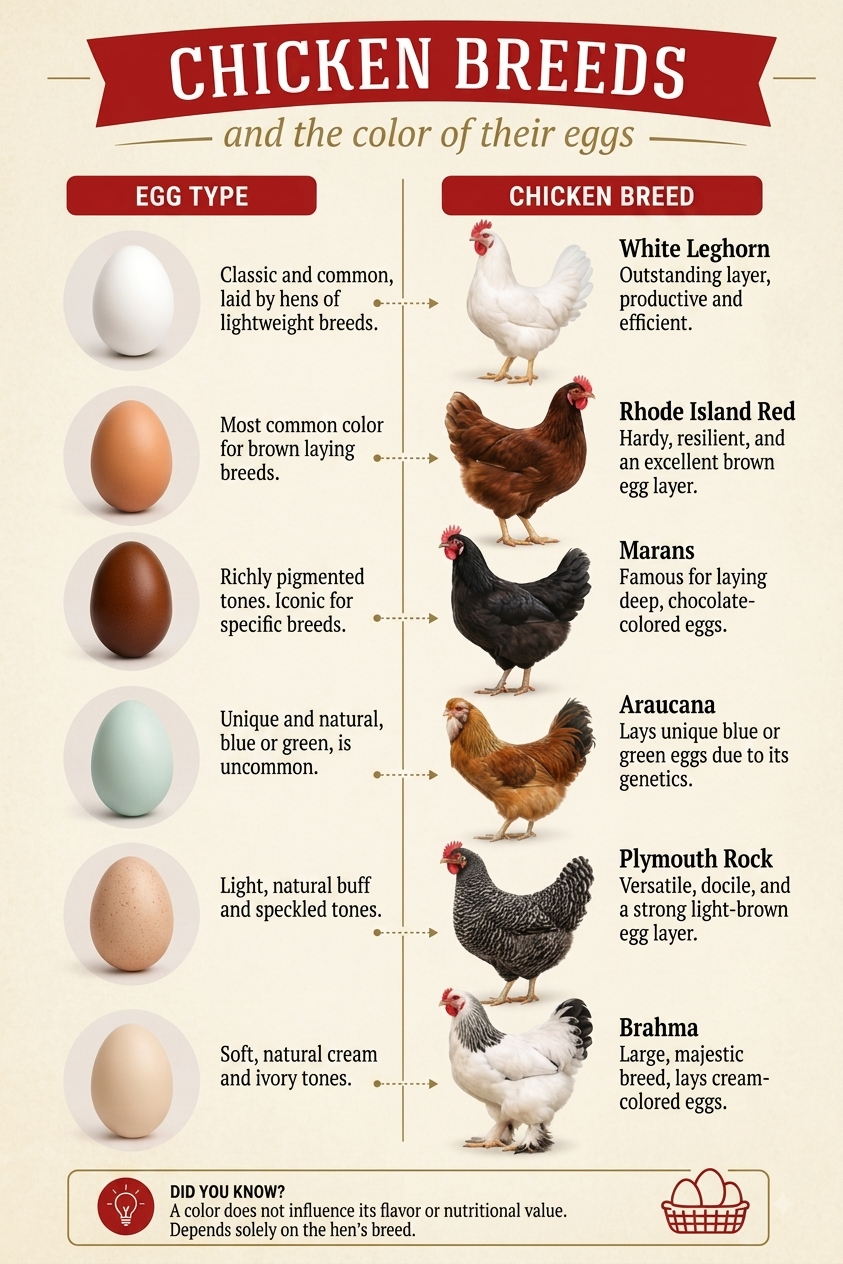
<li><strong>Leghorns:</strong> White</li>
<li><strong>Isa Brown/Lohmann:</strong> Deep Brown</li>
<li><strong>Ameraucana:</strong> Light Blue</li>
<li><strong>Marans:</strong> Dark Chocolate</li>
<li><strong>Easter Eggers:</strong> Variable (Blue, Green, Pink)</li>
<li><strong>Sussex:</strong> Light Cream/Tinted</li>
</ul>
<h2>Conclusion</h2>
<p>Choosing the right <strong>chicken breeds and egg colors</strong> is a strategic decision that affects your farm's bottom line and market identity. From the high-efficiency White Leghorn to the boutique Black Copper Marans, the variety available allows you to tailor your production to your specific audience. Remember, while color gets the customer's attention, the quality of your management—vaccinations, high-quality feed like Topfeed or Animal Care, and strict biosecurity—is what keeps them coming back.</p>
<p>Ready to take your farming business to the next level? <strong>Join Farming Tech & Business today</strong> for more expert insights, field-tested strategies, and the latest agricultural trends across Africa and the world!</p>