Maggot Farming in Nigeria: Complete Beginner’s Guide, Cost, Steps, Problems and Profitability
Quick Answer
Maggot farming is the controlled production of fly larvae, usually for use as a protein-rich feed ingredient for poultry, fish and other livestock. In Nigeria, farmers commonly explore black soldier fly larvae (BSFL) and other types of maggots because they can convert organic materials into useful insect biomass. The cost of starting depends heavily on the scale, rearing system, source of feedstock and whether equipment is bought or improvised. A small beginner setup can be started with locally available materials, while commercial production requires dedicated rearing, breeding, harvesting, processing and hygiene systems.
Key Takeaways
- Maggots are fly larvae, but not every type of maggot is equally suitable for livestock feed.
- Black soldier fly larvae (BSFL), Hermetia illucens, are increasingly studied as an alternative protein source for animal feed.
- Ordinary housefly maggots are different from BSFL and require particularly careful attention to hygiene and microbiological safety.
- Maggot farming can turn suitable organic by-products into useful insect biomass.
- Starting small is usually more sensible than investing heavily before understanding the insect's life cycle and local market.
- The biggest beginner problems are often poor breeding control, unsuitable substrates, excessive moisture, overheating, bad ventilation, contamination and harvesting at the wrong stage.
- Do not assume that every waste material is safe for producing feed insects. Research shows that contaminants in substrates can accumulate in larvae, particularly some heavy metals.
- Research in Nigeria and elsewhere has investigated maggot and BSFL meal as alternatives to conventional protein sources such as fish meal and soybean meal.
What Is Maggot Farming in Simple Terms?
Maggot farming is the practice of deliberately producing fly larvae under controlled conditions.
The basic idea is simple:
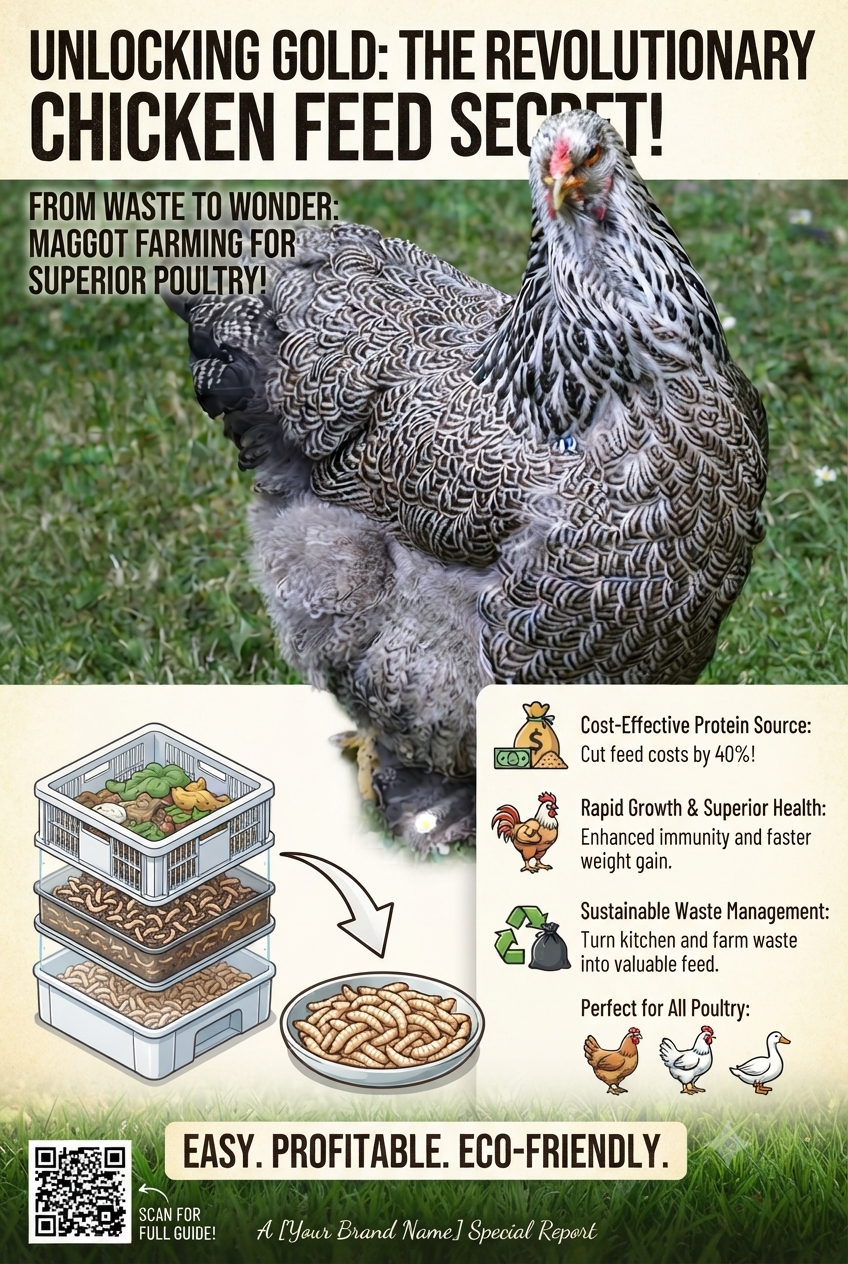
Suitable organic material → fly reproduction → eggs → larvae/maggots → harvesting → fresh or processed insect feed
The larvae consume an appropriate substrate while growing. Farmers then harvest them for uses such as animal feed, depending on the species, production system and applicable feed-safety requirements.
However, there is an important distinction.
Maggots Are Not One Single Insect
The word maggot simply refers to the larval stage of a fly.
Two groups that frequently appear in livestock-feed discussions are:
Type| Scientific name| Common relevance
Black soldier fly larvae| Hermetia illucens| Increasingly researched for livestock and aquaculture feed
Housefly maggots| Musca domestica| Historically used as poultry feed in some African farming systems
The Food and Agriculture Organization notes that housefly maggots have been used as poultry feed in Africa, but also warns that houseflies are associated with disease transmission and that bacteriological and mycological safety should be investigated before their use as feed.
That is why a serious maggot farming guide should not simply say, "collect flies from waste and feed the larvae to chickens."
Controlled production is very different from collecting larvae from uncontrolled waste.
Core Explanation
Why Are Farmers Interested in Maggot Farming?
Feed is one of the biggest expenses in livestock production.
FAO notes that protein sources such as meat meal, fish meal and soybean meal can represent a substantial proportion of livestock production costs.
Nigeria has also seen research and development interest in insect-based protein.
For example, Nigeria's National Research Institute for Chemical Technology describes work involving maggots and other insects as alternative protein sources for livestock feed.
A 2026 study involving farmers' cooperatives in Oyo State found that farmers viewed BSFL as a potentially affordable and sustainable alternative protein source, although actual BSF rearing adoption among the surveyed farmers was still low.
This creates an interesting opportunity:
organic by-products → insect biomass → livestock feed
But the economics only work when production is properly managed.
How Maggot Farming Works
A simplified production cycle looks like this:
1. Select the insect
First determine which insect you are producing.
If the goal is a structured insect-feed enterprise, BSFL is often considered because it has received extensive research attention as a feed ingredient.
2. Establish breeding stock
Adult flies produce eggs.
For a controlled operation, breeders need a suitable environment where adults can mate and lay eggs.
3. Collect eggs
The eggs are transferred to an appropriate larval-rearing substrate.
4. Larvae hatch
The newly hatched larvae begin feeding.
5. Larvae grow
The larvae consume the substrate and increase in size and biomass.
6. Harvest
The larvae are separated from the remaining substrate at the appropriate stage.
7. Use or process the larvae
Depending on the production system, larvae may be used fresh, dried or processed into a meal.
8. Manage the remaining material
The leftover rearing material may contain insect frass and residual substrate. Its appropriate use depends on its composition and contamination status.
How to Start Maggot Farming Step by Step
Step 1: Decide What You Want to Produce
Do not start by buying containers.
Start with the business objective.
Are you producing:
- Fresh larvae for your own poultry?
- Larvae for fish farming?
- Dried insect meal?
- Live larvae for sale?
- Breeding stock?
- A combination of these?
Your answer determines the production system you need.
Step 2: Identify Your Market
Before producing hundreds of kilograms of larvae, identify who will buy them.
Potential customers may include:
- Poultry farmers
- Fish farmers
- Feed producers
- Small livestock farms
- Other insect farmers
- Agricultural researchers
- Farmers interested in alternative protein ingredients
The strongest business model may be different from simply producing larvae for your own farm.
For example:
Poultry farmer: produces larvae → feeds them to chickens.
Commercial insect farmer: produces larvae → sells fresh larvae or processed meal.
Integrated farmer: produces larvae → feeds livestock → uses suitable residual material elsewhere on the farm.
Step 3: Choose a Suitable Production Area
A maggot production area should be:
- Easy to clean
- Protected from unwanted pests
- Well ventilated
- Protected from flooding
- Accessible for feeding and harvesting
- Large enough for future expansion
- Separated from household food-preparation areas
Do not underestimate hygiene.
A production facility that smells strongly, attracts uncontrolled flies or becomes difficult to clean can quickly become a management problem.
Step 4: Prepare Rearing Containers
Small-scale farmers can begin with suitable locally available containers.
Depending on the system, these may include:
- Plastic trays
- Buckets
- Crates
- Shallow containers
- Purpose-built insect-rearing trays
The container must allow you to manage:
- Moisture
- Feeding
- Ventilation
- Larval density
- Harvesting
- Cleaning
The cheapest container is not automatically the best container.
A container that makes harvesting difficult can increase labour costs later.
Step 5: Prepare the Substrate
The substrate is the material on which the larvae feed.
Possible materials vary according to the insect species and production system.
Examples can include suitable agricultural and food-processing by-products.
But this is one area where beginners need to be extremely careful.
Never assume that "waste" means "safe."
Research has demonstrated that contaminants present in insect-rearing substrates can affect larvae. In particular, studies have documented accumulation of some heavy metals such as cadmium and lead in BSFL.
Therefore, avoid treating unknown industrial waste, chemically contaminated material or questionable waste streams as automatically suitable for feed-insect production.
Step 6: Introduce Eggs or Establish Breeding
The next stage is to provide the eggs with an appropriate environment for hatching and larval development.
For commercial production, maintaining a reliable breeding population is important.
Depending on the species, this involves managing:
- Adult flies
- Mating
- Egg laying
- Egg collection
- Larval development
- Pupation
- Adult emergence
This is why serious maggot farming is more than placing waste in a bucket and waiting.
Step 7: Manage Larval Growth
During the larval stage, monitor the production system regularly.
Look at:
- Larval activity
- Moisture
- Temperature
- Odour
- Substrate condition
- Larval density
- Signs of contamination
- Growth uniformity
If something changes suddenly, investigate rather than simply adding more feed.
Step 8: Harvest at the Appropriate Stage
Harvest timing depends on the insect species and your intended use.
If your goal is feed production, you need a consistent harvesting system.
A commercial operation should eventually be able to answer:
- How much substrate entered the system?
- How much larval biomass was produced?
- How long did production take?
- How much labour was required?
- What percentage was lost?
- How much was sold?
- What was the production cost per kilogram?
Those figures are more useful for business planning than simply knowing that "maggots are profitable."
How Much Does It Cost to Start Maggot Farming in Nigeria?
There is no single fixed maggot farming cost in Nigeria.
The amount depends on the scale and production method.
A farmer using recycled containers and locally available organic material may spend far less than someone constructing a dedicated commercial insect-production facility.
Illustrative startup structure
Expense| Small setup| Larger setup
Rearing containers| Low| Medium–High
Breeding area| Low–Medium| Medium–High
Collection/harvesting equipment| Low| Medium
Substrate| Potentially low if suitable local materials are available| Medium
Drying/processing| Optional initially| Can become significant
Labour| Mostly personal labour| Increasingly significant
Hygiene/cleaning| Required| Required
Packaging| Low initially| Higher
Housing/shade| Low–Medium| Medium–High
Important: These are cost categories, not current Nigerian market quotations. Prices vary by location, material quality, scale and whether equipment is purchased, fabricated or recycled.
A better way to calculate your startup cost
Use this formula:
Total startup cost = infrastructure + containers + breeding stock + harvesting equipment + processing equipment + initial substrate + labour + packaging + contingency
For example:
If you already have a suitable shaded area and containers, your startup cost may be dramatically lower than someone starting from zero.
That is why copying another farmer's "₦X startup cost" can be misleading.
Is Maggot Farming Profitable in Nigeria?
It can be, but profitability should be calculated rather than assumed.
There is Nigerian research supporting the economic potential of insect-based feed.
One Nigerian study examining maggot meal as a replacement for fish meal in broiler diets reported reduced feed costs and higher net returns under the conditions of that experiment.
Research involving improved indigenous chickens has also reported economic benefits from diets containing BSFL meal, although results depend on the particular diet, inclusion level and production conditions.
A recent Nigerian report on insect slurry also specifically evaluated nutritional properties and economic feasibility for poultry production.
However:
Research results are not a guarantee of profit for every Nigerian farmer.
Your profitability depends on:
- Cost of substrate
- Larval survival
- Production time
- Labour
- Electricity
- Water
- Housing
- Processing
- Packaging
- Transportation
- Selling price
- Customer demand
- Scale of production
- Quality control
A Simple Maggot Farming Profitability Formula
You can calculate your business using:
Revenue = quantity of saleable larvae × selling price per kg
Then:
Gross margin = revenue − variable production costs
And:
Net profit = revenue − total operating costs
For an integrated poultry farm, you can also calculate the value of larvae used on your own farm.
That is important because your business may benefit from maggot production even when you do not sell the larvae.
---
Practical Example: Small Integrated Farm
Imagine a poultry farmer has access to suitable organic by-products and wants to produce insect biomass for use in the poultry operation.
Instead of thinking:
«"How much money can I make selling maggots?"»
the farmer could ask:
«"How much does producing my own insect protein cost per kilogram compared with buying an equivalent protein ingredient?"»
The calculation could include:
Item| Calculation
Substrate| ₦___
Labour| ₦___
Water/electricity| ₦___
Equipment depreciation| ₦___
Losses| ₦___
Processing| ₦___
Total production cost| ₦___
Larvae produced| ___ kg
Cost/kg larvae| ₦___
This gives you a much more useful business figure.
Maggot Farming for Beginners: What Equipment Do You Need?
A basic setup may require:
Production equipment
- Rearing trays
- Breeding containers
- Collection containers
- Suitable racks
- Covers or protective materials
- Weighing scale
- Cleaning equipment
Processing equipment
Depending on your production model:
- Draining/collection equipment
- Drying system
- Storage containers
- Packaging materials
- Grinder or milling equipment for meal production
You do not necessarily need all processing equipment on day one.
A farmer producing larvae for personal farm use has different equipment requirements from a commercial producer selling standardized dried insect meal.
Common Maggot Farming Problems and Solutions
1. Excessive Moisture
A substrate that becomes too wet can create unpleasant conditions and make harvesting difficult.
What to do
Monitor moisture regularly and adjust the substrate-management system rather than continuously adding material.
2. Bad Odour
Strong uncontrolled odour can indicate poor substrate management, excessive moisture, overcrowding or decomposition problems.
What to do
Review:
- Substrate quantity
- Moisture
- Ventilation
- Larval density
- Cleaning schedule
3. Larvae Are Not Growing Properly
Possible factors include:
- Unsuitable substrate
- Poor environmental conditions
- Excessive density
- Inadequate moisture
- Poor-quality breeding stock
- Contamination
Do not immediately assume that the larvae simply need more feed.
4. High Larval Mortality
Sudden mortality requires investigation.
Check:
- Temperature
- Moisture
- Substrate quality
- Chemical contamination
- Overcrowding
- Disease or microbial contamination
- Handling practices
5. Too Many Unwanted Flies
A poorly controlled facility can become a breeding point for insects that you did not intend to produce.
What to do
Improve:
- Breeding control
- Screening
- Cleaning
- Waste management
- Separation of production stages
6. Contaminated Feedstock
This is one of the most important problems.
If larvae are intended for livestock feed, the substrate becomes part of the food-safety equation.
Research has shown that some contaminants can accumulate in BSFL, particularly heavy metals.
What to do
Know where your substrate comes from.
Do not blindly use:
- Industrial waste
- Chemically contaminated materials
- Unknown waste streams
- Materials contaminated with pesticides or other hazardous substances
7. Poor Harvesting
Harvesting too early or too late can affect the characteristics and intended use of the product.
Develop a consistent harvesting system rather than harvesting randomly.
Maggot Farming Mistakes to Avoid
Mistake 1: Starting Too Big
A beginner may see videos of large insect farms and immediately want thousands of trays.
That is unnecessary.
Start with a manageable production unit.
Learn the system.
Measure your results.
Then expand.
Mistake 2: Using Any Available Waste
Cheap does not automatically mean suitable.
The substrate must be considered from both a production and feed-safety perspective.
Mistake 3: Confusing Housefly Maggots With BSFL
They are not the same insect.
This distinction matters because their biology, management and safety considerations differ.
Mistake 4: Ignoring the Breeding Stage
Some beginners focus entirely on larval feeding.
But if you want a sustainable production system, you also need to understand the adult and reproductive stages.
Mistake 5: Producing Without a Market
Before scaling up, know who will use the larvae.
Your customers might be:
- Poultry farmers
- Fish farmers
- Feed manufacturers
- Other insect farmers
- Integrated farms
---
Mistake 6: Assuming Maggots Automatically Reduce Feed Costs
Maggots only reduce feed costs if the total economics make sense.
Include labour, substrate, processing, losses and other operating costs.
Mistake 7: Giving Livestock Unprocessed or Poorly Controlled Larvae
The safety of insect feed depends on factors including species, substrate, production conditions and processing.
Do not copy an inclusion rate from another farm and assume it is universally appropriate.
Research results are specific to the animal, insect product, diet and experimental conditions.
For example, a 2026 Nigerian broiler study investigated 1%, 2% and 3% maggot-meal supplementation under its particular experimental conditions and reported no adverse haematological effects up to 3%. That does not establish 3% as a universal recommendation for every poultry ration.
How to Improve Maggot Production
A serious farmer should eventually track production data.
Create a simple record sheet containing:
Record| What to monitor
Date| Production start date
Substrate| Type and quantity
Eggs| Quantity/weight where measurable
Larvae| Harvested quantity
Production period| Number of days
Losses| Dead/unusable larvae
Labour| Hours spent
Costs| Total variable cost
Sales| Quantity and revenue
Customer| Buyer/use
After several production cycles, you will have your own numbers.
Those numbers are much more valuable than generic internet claims about how much money maggot farming "can make."
Can Maggot Farming Be Combined With Poultry Farming?
Yes.
This is one of the interesting possibilities of integrated farming.
A poultry farmer can potentially produce insect biomass and use it as one component of a broader feed strategy.
But larvae should not automatically replace the entire poultry ration.
Poultry require balanced diets containing appropriate energy, protein, amino acids, minerals, vitamins and other nutrients.
Insect meal is an ingredient, not a magic replacement for a complete feed formulation.
Research has investigated different levels of BSFL meal in poultry diets, including studies involving indigenous chickens and broilers.
Common Misconceptions About Maggot Farming
"All maggots are the same."
False.
Maggot is a general term for fly larvae. Different species have different characteristics and management requirements.
"Maggots are simply rotten waste."
False.
The larvae are living organisms that convert suitable organic material into insect biomass.
"Any waste can be used."
False.
Substrate quality is important for both larval performance and feed safety. Research has demonstrated that certain contaminants can accumulate in larvae.
"Maggot farming is automatically profitable."
False.
Profit depends on production efficiency, costs, market price and scale.
"Maggot meal can replace every protein ingredient."
False.
The appropriate use of insect meal depends on nutrient composition, processing, animal species, diet formulation and research evidence.
"You need an expensive factory to start."
Not necessarily.
A small experimental or farm-integrated system can be much simpler.
However, commercial production requires increasingly serious investment in hygiene, breeding, environmental control, harvesting, processing, storage and quality assurance.
FAQs About Maggot Farming
What is maggot farming?
Maggot farming is the controlled production of fly larvae for purposes such as animal feed, depending on the species and production system.
Is maggot farming profitable in Nigeria?
It can be profitable under suitable production and market conditions. Nigerian research has reported economic benefits from using maggot meal or BSFL meal in certain poultry-feed experiments.
However, profitability varies by farm and should be calculated from actual production costs and selling prices.
How much does it cost to start maggot farming in Nigeria?
There is no universal startup cost. A small setup using existing space and locally available materials can require relatively little capital, while commercial production can require substantially more for housing, breeding, trays, processing and quality control.
The most accurate method is to build your own budget from equipment, substrate, labour, processing and operating costs.
What are the common mistakes beginners make in maggot farming?
Common mistakes include starting too large, using unsuitable waste, confusing different fly species, ignoring breeding management, poor moisture control, overcrowding, poor hygiene, inadequate harvesting systems and producing without a clear market.
How long does maggot farming take?
The production period depends on the fly species, environmental conditions, substrate and production objective. Farmers should establish their own production records rather than relying on one universal number of days.
Can maggots be fed to chickens?
Some insect larvae have been investigated as poultry-feed ingredients. However, safety and nutritional suitability depend on the species, substrate, processing and diet formulation. Research has demonstrated potential for both housefly maggot meal and BSFL-based diets, but results should not be generalized beyond the conditions studied.
Can maggots be used for fish farming?
Insect larvae and insect meals have been investigated as alternative protein ingredients in aquaculture. BSFL meal, in particular, has been studied as a possible alternative to conventional protein sources in aquafeeds.
Is black soldier fly the same as a housefly?
No.
The black soldier fly is Hermetia illucens, while the common housefly is Musca domestica.
Their larvae are both sometimes called maggots, but they are different insects.
Can I use kitchen waste for maggot farming?
Some organic materials may be suitable, but "kitchen waste" is too broad to automatically classify as safe.
The substrate should be selected according to the insect species, production system and intended use of the larvae. Contamination is a major consideration when larvae will enter an animal-feed chain.
What is the best way to start maggot farming for beginners?
Start small, learn the insect's complete life cycle, establish a controlled production system, measure your input and output, identify your market and expand only after you can consistently produce good-quality larvae.
Conclusion
Maggot farming is more than putting organic waste into a container and waiting for larvae to appear.
A successful system requires an understanding of insect biology, breeding, substrate management, hygiene, harvesting, processing, feed safety and economics.
For Nigerian farmers, the opportunity is particularly interesting because alternative protein sources are being investigated as a way of reducing dependence on conventional feed ingredients. Nigerian research has already examined both maggot meal and black soldier fly larvae in livestock feeding systems.
But the smartest way to approach the business is to start with the numbers:
What will I spend?
What quantity can I produce?
What will each kilogram cost me?
Who will buy it?
What value will it create on my own farm?
Once you can answer those questions with your own production records, you can make much better decisions about whether to remain small, integrate maggot production into your farm or develop it into a commercial insect-production business.
Related Guides
- Black Soldier Fly Farming for Beginners
- How to Produce Maggot Meal for Poultry Feed
- Alternative Protein Sources for Poultry Feed
- How to Reduce Poultry Feed Costs
- Chicken Feed Formulation for Beginners
- Integrated Farming Systems for Small Farms
Want to Go Deeper?
If you want to move from simply understanding maggot farming to learning how to actually structure production, manage the process and understand how alternative ingredients can fit into livestock feeding, our Chicken Feed Formulation Guide provides a practical next step for farmers who want to understand feed formulation rather than simply follow random recipes online.